How to build a knowledge base for AI that gives correct answers
A knowledge base for AI needs current articles, one owner each and one version of every answer, because assistants repeat what they find. What research shows.

A knowledge base for AI is the set of articles and documents that an AI assistant or agent searches to answer questions. It is reliable enough when every article is correct today, has a named owner, carries a review date and says clearly what it replaced. Language models repeat what they retrieve: an outdated document produces an outdated answer, given with the same confidence as a correct one.
AI is now widely used, and measured value is still rare. A survey run from May to July 2026 asked nearly 9,000 senior executives in seven countries, including the United States, the United Kingdom and Germany. It found that 78% of firms used AI, yet 83% of executives reported no impact on labour productivity over the past three years. That survey does not say why. This article covers the part that research can explain: what happens when the knowledge underneath an assistant is wrong, and what to check before you connect one. The general method, with or without AI, is in our guide on how to keep a knowledge base accurate.
Why an AI assistant repeats what your knowledge base says
An assistant at work rarely answers from memory. It first retrieves passages from your content, then writes its answer from them. This is retrieval-augmented generation (RAG). It makes answers traceable, and it moves the weak point to your content: an answer is now only as good as the passages retrieved for it.
Several studies published in 2026 measured what happens when those passages are wrong.
| Study | What was tested | What it found |
|---|---|---|
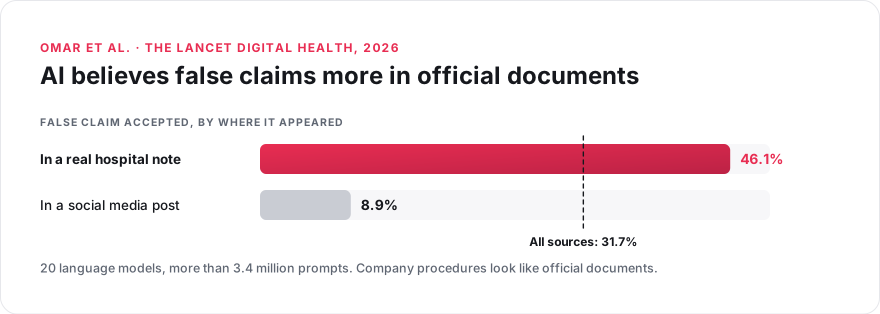
| Omar et al., The Lancet Digital Health, January 2026 | 20 models, more than 3.4 million prompts containing medical misinformation | The false recommendation was accepted in 46.1% of cases when it sat in a real hospital discharge note, and in 8.9% when it came from social media |
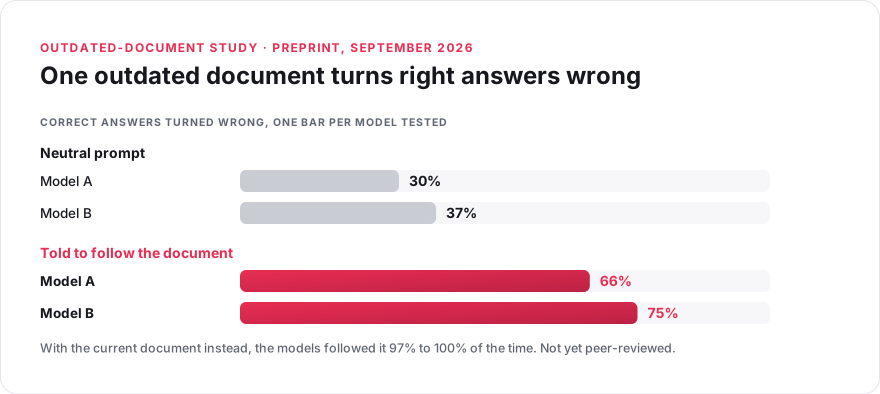
| Ahmed, Galke Poech and Röttger, University of Southern Denmark, September 2026, preprint, not yet peer-reviewed | 317 cases where the right answer had changed, in medicine, law, software and platform rules | One outdated document overturned 30% to 37% of the answers that two models got right without it |
| Wallat, Nejdl and Sikdar, Findings of ACL 2026 | Facts that changed recently, compared with stable facts | Larger models notice that a fact has changed, but their answers do not follow |
| Yuan et al., ACL 2026 | 1,814 real questions, 57% of them with retrieved passages that contradict each other | The best model scored 0.466 at sorting the conflicting answers; people scored 0.69 |
The first result matters most for a company. False content was accepted about five times more often when it was written like an official document. Procedures, policies and product sheets look official in exactly that way.
The second result also shows what helps. When the models were given the current document instead, they followed it 97% to 100% of the time. A date on its own helped little. A clear statement of when the old guidance stopped applying let large models switch to the current answer almost every time.
What a knowledge base for AI agents needs
None of the properties below is new to knowledge management. AI makes the cost of a missing one visible, because an assistant repeats what it finds to everyone who asks. APQC, a non-profit benchmarking body, put it plainly in its 2026 priorities survey: AI "exposes weaknesses in content quality, governance, taxonomy, and ownership".
| Property | What it means | Why AI needs it |
|---|---|---|
| Current | Each article has a review date, and a replaced article says what replaced it and from when | One outdated document can overturn correct answers |
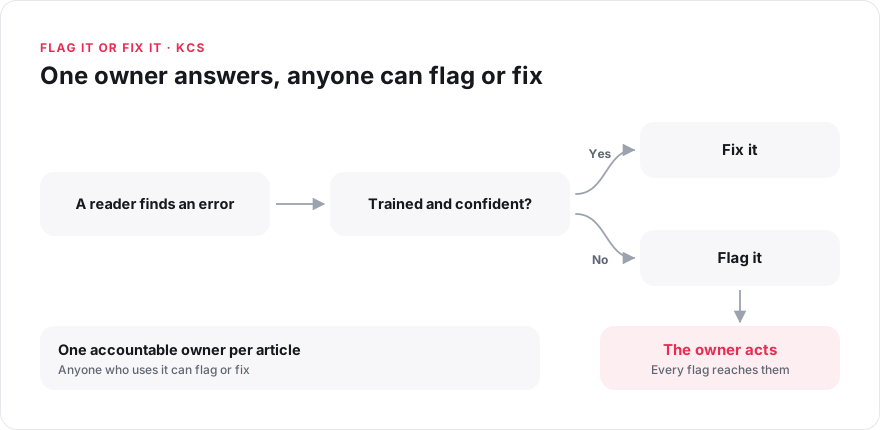
| Owned | One named person is responsible for each article, and any reader can flag or fix an error | A reported error has to reach someone who can act |
| Unique | One version is authoritative for each answer | Models handle contradicting sources poorly |
| Complete for real questions | The questions people ask most have an article that answers them | When the answer is missing, an assistant may produce one anyway |
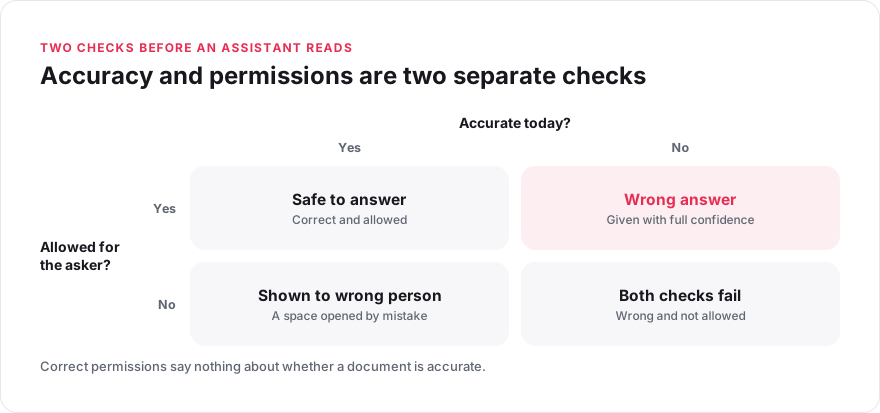
| Permissioned | The assistant sees only what the person asking may see | One answer can combine documents with different access rights |
One owner per article, corrections open to everyone
KCS (Knowledge-Centered Service, renamed Knowledge-Centered Success in April 2026) is a method from customer support, and it gives the simplest rule: "flag it or fix it". Whoever uses an article fixes the errors they are sure about and flags the rest, and every flag must reach someone who can act on it. KCS also warns about the opposite failure: when each article belongs to one person, others hesitate to edit it and create duplicates instead. The two fit together: one named owner per article, and corrections open to everyone who uses it.
One version that counts
For an assistant, two near-identical procedures are two possible answers, and the study by Yuan et al. shows that even the best models struggle to choose. Merge duplicates, archive what is no longer true, and write in the old article what replaced it, with the date. An archived article leaves search, and its history stays available.
Missing content matters as much as wrong content
In a 2024 study of three real RAG systems, the first of seven failure points was missing content: when the answer is not in the documents, the system can still produce one. The authors concluded that such a system can only be fully validated once people use it. Questions that get no answer therefore show which articles to write next.
Permissions are a separate check from accuracy
France's national cybersecurity agency, ANSSI, asks that a generative AI system give access on a need-to-know basis from its design onwards, and that AI tools' access rights be reviewed when they are activated, then regularly. A space opened to the whole company by mistake will be read by the assistant like any other. Correct permissions say nothing about whether a document is accurate.
How to build a knowledge base for AI, step by step
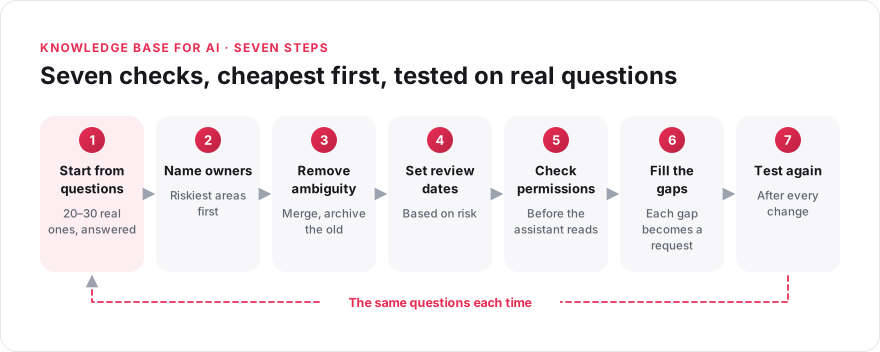
This order puts the cheapest checks first.
- Start from real questions. Collect 20 to 30 questions your teams really ask, with the answer an expert would give. Ask the assistant, open the source behind each answer, and mark it right, out of date, wrong, missing or not allowed for that person.
- Name an owner for each domain and each article. Start where an error costs most: safety, legal matters, promises to customers.
- Remove ambiguity. Merge duplicates, archive what has been replaced, and say in each old article what replaced it and from when.
- Give every article a review date. Base it on risk and write down why. Our guide to knowledge base maintenance compares what the sources say about how often to review.
- Check permissions before the assistant reads anything. Look for spaces open to everyone by mistake, and review what the assistant may read.
- Fill the gaps. Turn each unanswered question into a request for an article, with an owner.
- Test again after every change to the content, the model or the connection, with the same questions.
Governance of AI knowledge: what the rules say
The rules leave most of this to you. Article 10 of the EU AI Act, on data, covers the training, validation and testing data of high-risk systems. For an ordinary office assistant that reads your documents, no article sets a rule on their quality. France's data protection authority, the CNIL, tells organisations to check outputs and to prefer systems that cite their sources (2024, in French). ANSSI adds that a generative AI system should not take critical decisions without human control. Our guide to AI knowledge management covers the AI Act, the security guidance and the protocols that connect AI agents to knowledge.
The sources do not answer three questions: how often to review, how to reassign articles when a team changes, and how to measure whether a knowledge base is accurate. Write your own rule for each, and apply it the same way in every domain.
Where the sources stop: how we do it in Elium
Elium is a European knowledge management platform, organised in spaces that each have their own managers. Each article has one owner and can carry a verification date: as the date approaches, the article appears in its owner's task list, and a badge tells readers whether it is verified or expired. Archived articles leave search and can be restored.
AI agents connect through the Model Context Protocol (MCP), and every call runs with the permissions of the person signed in. When an agent reads an article, it also receives its owner, its review or expiry date, its approval status and whether it is archived, so it can tell current guidance from outdated guidance. Unanswered questions can become article requests assigned to a contributor.
At the Département de l'Orne, 25 IT professionals support 1,800 staff. Every procedure has an expiry date and an annual review, so 100% of procedures are current. Technicians get answers from the AI assistant directly inside their tickets in GLPI, their IT service desk tool.
Common questions
A knowledge base for AI is the set of articles and documents that an AI assistant or agent searches to answer questions. It is reliable when each item is correct, has an owner, carries a review date and has no competing version.
Start from 20 to 30 real questions, name an owner for each article, merge duplicates, give every article a review date, check permissions, then test again after every change. Choosing the tool comes after.
AI cannot keep a knowledge base up to date by itself: it can spot content that looks outdated, duplicated or missing, but only a person can decide what is true today. Our article on how AI helps keep a knowledge base accurate explains what AI detects and where a person has to decide.
ChatGPT answers from its training data unless it is connected to other sources, such as company files or a knowledge platform. Once connected, its answers about your company are only as good as those sources.
One whose hosting, applicable law and access you can choose, connected to documents that are kept current: sovereignty protects your data, not the accuracy of the answers. ANSSI rules out public online generative AI tools for professional work involving sensitive data. A model hosted in Europe repeats an outdated document like any other, which is why owners and review dates still matter.
That it answers only from documents each person may already open, cites its sources and runs where professional secrecy is respected. In France, lawyers' consultations, correspondence and case files are covered by professional secrecy (Article 66-5 of the law of 31 December 1971), and chartered accountants are bound by it too (Article 21 of the ordinance of 19 September 1945). Law and tax rules change often, so dated templates and notes with an owner matter as much as the tool.
Where to go next
Compare tools. Our comparison of AI knowledge base software shows what to check before you choose.
Use a template. The content review schedule and the knowledge audit checklist put this article into practice.
Do it in Elium. Our documentation explains verification dates, article ownership, approval and connecting AI agents through MCP. For sovereignty requirements, see our on-premise option.
Read next. Keep a knowledge base accurate, AI knowledge management, what is a knowledge base and WYKIWYG: what you know is what you get.
Sources
- Omar et al., Mapping the susceptibility of large language models to medical misinformation across clinical notes and social media, The Lancet Digital Health, January 2026 (abstract read on PubMed).
- Ahmed, Galke Poech and Röttger, Stale-document poisoning: when outdated retrieval overrides correct model answers, preprint, 25 September 2026.
- Wallat, Nejdl and Sikdar, When facts change: temporal knowledge conflict resolution in LLMs, Findings of ACL 2026.
- Yuan et al., Benchmarking LLM's capability in reasoning over conflicting web references, ACL 2026.
- Barnett et al., Seven failure points when engineering a retrieval augmented generation system, CAIN 2024.
- Yotzov, Barrero, Bloom, Bunn, Davis et al., Firm data on AI, NBER Working Paper 34836, revised October 2026, not peer-reviewed.
- APQC, 2026 KM priorities and trends, executive summary, May 2026.
- Consortium for Service Innovation, Knowledge-Centered Success Practices Guide (2027), published 2026, techniques 2.2 and 5.3.
- ANSSI, Recommandations de sécurité pour un système d'IA générative, 29 April 2024 (in French).
- CNIL, questions and answers on using a generative AI system, 18 July 2024 (in French).
- European Union, consolidated AI Act, Article 10.
- Légifrance, Article 66-5 of law no. 71-1130 of 31 December 1971 and ordinance no. 45-2138 of 19 September 1945, Article 21.
Sources checked on 20 October 2026.


